What Is Drainage Pipe Slope?
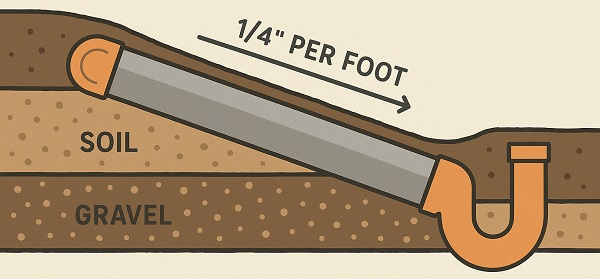
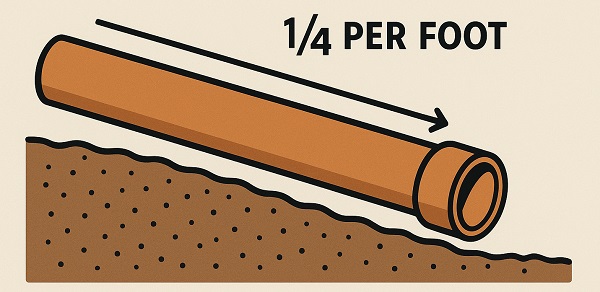
Drainage pipe slope, or grade, is the amount a pipe falls vertically over a given horizontal distance. It is usually expressed as a percentage, a ratio, or inches of fall per foot of run. Too little slope allows solids to settle and cause blockages, while too much slope can let water outrun solids, also increasing the risk of clogs and noisy operation.
Typical Minimum Drainage Pipe Slopes
Local plumbing and drainage codes vary, but many systems use minimum slopes within the following general range:
- 1½"–2" (40–50 mm) pipe: about 1/4" per foot (approximately 2.0% slope)
- 3" (75 mm) pipe: about 1/8"–1/4" per foot (approximately 1.0–2.0%)
- 4" (100–110 mm) pipe: about 1/8" per foot (approximately 1.0% slope)
- Larger diameters: often use smaller minimum slopes
Always verify your final design against your local plumbing code or relevant drainage standard. This calculator is a design aid and not a substitute for professional review.
Tip: If you are unsure what slope to use, start with the suggested minimum slope for your pipe diameter, then adjust if your site conditions and local code allow it.
Typical Minimum Slopes by Diameter (Guide Only)
Use as a quick planning guide. Always verify against your local standards, sewer authority manuals, and project specifications.
| Diameter (mm) |
Diameter (in) |
Typical Minimum Grade (%) |
Approx. Fall (in/ft) |
Notes |
| 100 | 4 | 1.0–2.0 | 0.12–0.24 | House laterals; keep ≥ self‑cleansing velocity. |
| 150 | 6 | 0.5–1.0 | 0.06–0.12 | Common sanitary collector sizes. |
| 200 | 8 | 0.3–0.6 | 0.036–0.072 | Check for partial‑flow conditions in storms. |
| 250 | 10 | 0.2–0.4 | 0.024–0.048 | Larger mains often governed by capacity. |
| 300 | 12 | 0.15–0.30 | 0.018–0.036 | Confirm n and deposit control strategy. |
- 1% grade ≈ 10 mm/m ≈ 0.12 in/ft.
- Ranges assume clean, smooth pipes; sediment increases required grade.
Common Manning’s n Values (Reference)
Pick the roughness closest to your material and condition. When in doubt, be conservative.
| Material |
n (typical) |
Condition / Notes |
| PVC / HDPE (smooth) | 0.009 | New, smooth interior; low headloss; sensitive to joints and deposits. |
| Ductile Iron (cement‑mortar lined) | 0.011 | Well‑lined and maintained; scale increases n over time. |
| Concrete | 0.012 | Cast/precise finishes trend lower; aging and seams trend higher. |
| Vitrified Clay / Brick | 0.013 | Use higher values if joints are irregular or sediments expected. |
| Corrugated Metal (CMP) | 0.022–0.030 | Depends on corrugation; consult manufacturer data. |
The calculator’s preset button fills 0.009, 0.011, 0.012, and 0.013 for convenience.
Worked Example – Residential Sewer Line
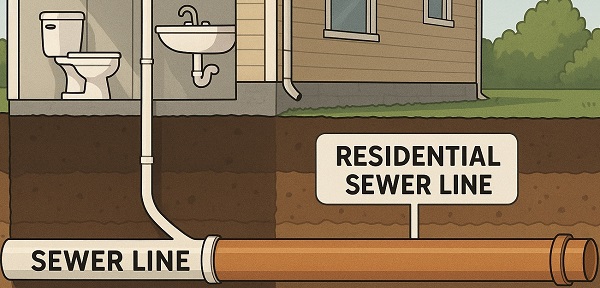
Imagine running a 4-inch sewer line from a house to a septic tank:
- Horizontal run: 40 ft
- Chosen slope: 1/4" per ft
The required fall is calculated as:
40 ft × 0.25 in/ft = 10 inches total fall
The calculator will also show:
- Slope: approximately 2.08%
- Fall: 10 inches = 254 mm
This allows you to check whether the design meets typical minimum slope recommendations and if the available site elevation allows for the required fall.
Worked Example – Yard Drainage in Metric
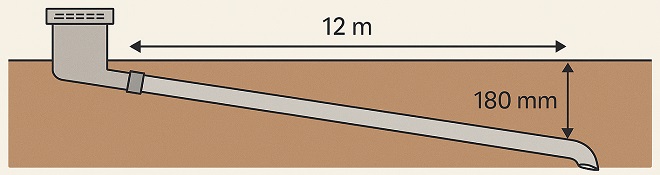
A 100 mm yard drain runs 12 m to a discharge point. You choose a 1.5% slope.
The required fall is:
12 m × 1.5% = 12 × 0.015 = 0.18 m = 180 mm
The calculator converts this slope into millimetres per metre and inches per foot, so you can mark out trench levels in whichever units you prefer.
When Slope Is Too Flat or Too Steep
Both insufficient and excessive slopes can cause performance issues:
Too Flat
- Slow flow velocity
- Solids settle out in the pipe
- Frequent clogs or backups
- Standing water remaining in the line
Too Steep
- Water outruns solids, leaving debris behind
- Increased noise and air movement in the system
- Potential for exposed pipe at outlet or shallow cover
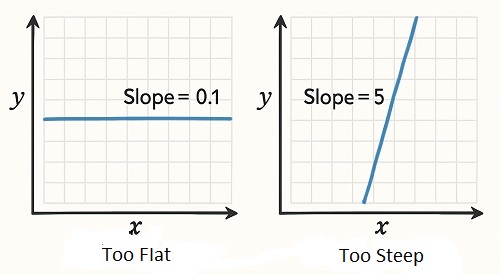
The goal is a self-cleansing slope: steep enough to move solids, but not so steep that water and debris separate.
Practical Tips for Setting Drainage Pipe Slope
- Check starting and ending elevations before digging.
- Use a laser level or string line and spirit level to set fall accurately.
- Keep slope as consistent as possible along straight runs.
- Allow for obstructions, fittings, and minimum cover depths.
- Consult a plumber or civil engineer for complex drainage layouts.
FAQs – Drainage Pipe Slope
What is a typical slope for a residential drainage pipe?
For small residential sewer and drain lines, slopes between about 1.0% and 2.0% are common. A 4-inch pipe often uses around 1/8" to 1/4" fall per foot, subject to local code and site conditions.
Is a steeper slope always better for drainage pipes?
No. If the slope is too steep, water can outrun solids, leaving debris behind and increasing blockage risk. The aim is a balanced, self-cleaning slope that keeps both water and solids moving together.
How do I convert slope from percent to inches per foot?
Divide the slope percentage by 100 to get the decimal slope, then multiply by 12 to find fall in inches per foot. For example, a 2% slope becomes 0.02 × 12 = 0.24 in/ft, which is roughly 1/4" per foot.
Can I use this calculator for stormwater and yard drains?
Yes. The calculator works for any gravity drainage pipe where slope matters, including sewer lines, stormwater pipes, yard drains, French drains, and roof drains. Always confirm design slopes with local drainage standards.
Do I still need to check my local plumbing code?
Yes. This tool offers typical values and design help, but plumbing and drainage codes vary by region. Always confirm final slopes and pipe sizes with the relevant code or a licensed professional before construction.
What if my available fall is less than the recommended minimum slope?
If you do not have enough fall, you may need to shorten the run, increase the pipe size, reroute the line, or use a pump. Installing a pipe below the recommended slope can lead to chronic blockages and costly maintenance.